
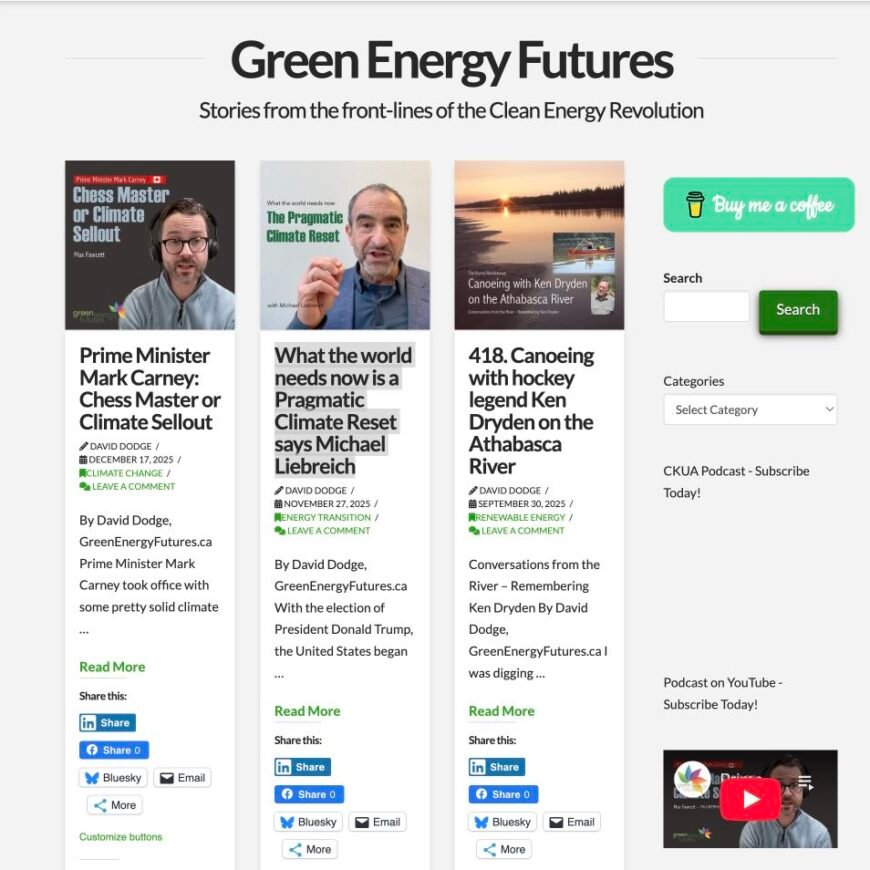
We are pleased to present our Best of 2025 Green Energy Futures stories.
Let’s face it, 2025 was a weird year with trade wars, tariffs, wars and geopolitical turmoil in general. We were going to invite a guest to talk about some of these issues, but it was going to be a collection of mostly bad stories, which you can relive anytime on the Web.
So instead, we thought we’d look back at some of our favourite Green Energy Futures stories from 2025.
Solar & Sheep
We began the year with our story on First-generation farmer Janna Greir, who moved to Alberta with her husband Ryan, along with the dream of buying a small farm.
Janna Greir always loved the idea of ranching, living in the country, and operating a small farm, but becoming a first-generation farmer is nearly impossible these days.
“My husband (Ryan) and I are both from Vancouver Island,” says Greir. “We didn’t grow up on farms; we’re first-generation, but we knew that we had an interest in agriculture.”
Then Janna discovered “solar grazing” from some friends who were doing it in Ontario. By coincidence, Capital Power was building a solar farm just outside Strathmore, Alberta, just a short distance down the road from their ranch.
Janna landed a contract to manage the vegetation on the solar farm and, within a couple of years, was running 1,000 sheep on it. Janna also learned a great deal about vegetation management, and the land under the solar farm is now more productive than it ever was.
It’s an inspiring story, and later last year Janna landed another contract with another solar farm and her operation is thriving.
Agrivoltaics is a new way for farmers to increase the financial and vegetative productivity of their farms.
Blatchford Carbon Neutral Community
Then mid year we did a series on Blatchford, the largest planned carbon-neutral community in North America.
We did a story years ago when it was just getting started, but we wanted to check back in now that things are really starting to take off in this very ambitious green neighbourhood in Edmonton, Alberta.
“You know, at the time, I would suggest it was wildly ambitious, the idea of a carbon-neutral community, very far out there. But, in the meantime, the rest of the world has sort of started coming along this way,” is how City Councillor Anne Stevenson summed it up in our story.
Blatchford has a near-net-zero building code, a geothermal district energy system to heat and cool the homes and some builders there are building fully net-zero homes these days.
In our series, we talked to residents Heather MacKenzie and family, and Josh Culling, about what it’s like living in Blatchford, and Kasandra Starkell and Martin Martinyiak, who bought a solar-powered net-zero home here. We did a special story on the “magic of heat pumps,” which are how homes are heated and cooled in this green community and Landmark Homes, a company that is building net-zero homes in Blatchford.
Video stories in our Blatchford series
The Magic of Heat Pumps
One of the coolest things about Blatchford is how the homes are heated and cooled by heat pumps. Residents we spoke to loved their heat pumps. Blatchford has a geothermal district energy system. Some people are surprised how flexible heat pumps are as Steve Oslanski of Envirotech Geothermal explained in our story on “The Magic of Heat Pumps.”
He is standing in the mechanical room of a home in Blatchford as he explains.
“Coming out of the district energy system here, which is provided by the City of Edmonton, the fluid runs into our GeoSmart Premium Q quad function heat pump, which does both forced air heating and cooling as well as in-floor heat. Heat pumps are awesome – they’re 400 percent more efficient than the most efficient natural gas furnace or boiler,” says Oslanski.
Landmark Homes is building fully net-zero homes in Blatchford and Micah Dueck. Asked what their secret is, he responded: “I think the first and foremost is the heat pump, which is the technology that we utilize to heat and cool the home. When heating the home, it’s about a 300 percent gain in efficiency. When cooling the home, it’s close to a 700 percent gain in efficiency, which is otherworldly.”
Heat pumps are poised to be the number one way of heating buildings in the near future. Ironically the fastest adoption rates are in the Nordic countries such as Norway. Ironic because one of the current myths is that heat pumps don’t work in cold countries.
Can an air source heat pump work in northern Canada?
We did our own experiment by installing a heat pump in one of the most unlikely use cases in Canada.
We called the story “Installing an air-source heat pump in a 2×4-walled cabin – worst case scenario?“
In the first winter, temperatures plunged to -40C, and that was one of the only times our backup electric heater came on. The heat pump is rated to -35C and it worked as advertised. Check out the story for all the details.
Most important story of 2025 – The Pragmatic Climate Reset
Finally, one of my personal favourite stories from 2025 was the long-form interview we did with Michael Liebreich, who wrote an essay entitled “The Pragmatic Climate Reset.“
In the wake of the geopolitical turmoil that has engulfed the world, the president of the United States abandoned climate action and retreated to a focus on fossil fuels.
Some even pronounced the energy transition dead.
But as Al Gore said in a podcast, there is only one country out of 158 that has pulled out of the Paris Accord, and the world is marching forward with the energy transition with or without the US.
Michael Liebreich told us the energy transition is far from dead, but that a new, more pragmatic approach is needed – one with less polarization, realistic goals and less absolutism.
In one example, he explained that by shooting for 90% clean energy instead of 100% and by using natural gas instead of banning it, you can get 90% of the way to net-zero quickly and affordably.
Using Chile as an example, he explained that by replacing 25% of coal-fired power capacity with flexible gas, you can dramatically slash emissions.
“The answer is you need not as much as 25% capacity like the coal has. You would need less than that, let’s say half of that, 12% capacity, but you wouldn’t use it all the time. You would use it 4 % of the time. So you’ve gone from 25% coal to 4% gas. It’s a huge colossal climate win,” he says in our interview.
Check out our story and then if you want to do a deep live listen to our full 1.5-hour interview. Be sure to subscribe to our audio podcast and our YouTube Channel.
Given the state of economic and political chaos in the world in 2025 and the fact that the world exceeded 1.5 °C of warming in 2024, Liebreich’s pragmatic approach seems to be striking a chord with many, if our audience is any indication.
2025 was a chaotic year for humanity, but ending with a simple, straightforward, pragmatic approach to addressing the climate crisis offers at least a little hope for the future.
Best wishes to all of you for 2026.
Green Energy Futures CKUA Podcast
Subscribe Today for weekly uplifting stories about people doing inspiring things in the energy transition.
