

By David Dodge, GreenEnergyFutures.ca
With the election of President Donald Trump, the United States began halting action on climate change and retreating to fossil fuels, leaving some to wonder if the energy transition was dead.
The world’s focus shifted almost overnight from concern about the impacts of climate change to concerns about the global economy as the US president began tariff wars around the world.
This has also led to some people to proclaim that the energy transition is dead.

Even in Canada, the newly elected Prime Minister Mark Carney, known for his work on climate change, began focusing new trade relationships and “nation building” projects which focus on fossil fuel development.
This has led the UK’s former Prime Minister Tony Blair and conservative analysts to pronounce the energy transition as dead and to call for climate resets, or a new kind of climate realism.
Michael Liebreich is an expert in energy transition, host of the Cleaning Up Podcast and the founder of Bloomberg New Energy Finance.
In his bid to take control of the “reset” narrative, he’s written two long essays in Bloomberg New Energy Finance: The Pragmatic Climate Reset – Part I and The Pragmatic Climate Reset – Part II.
Perfection is the Enemy of the Good
He says it’s high time for us to change our approach to climate change to something that’s more inclusive, has achievable goals, and is affordable and pragmatic.
In his version of the climate reset, we stop demonizing people, we stop scaring people with hard-to-defend worst-case scenarios, we end absolutism and adopt a plan that is achievable and above all, affordable.
Indeed, climate change does tend to polarize us between those who fear end-of-the-world scenarios and those who are simply worried about their jobs and families.
Liebreich says the worst-case scenarios designed to scare us are too easy to shoot down, and all-or-nothing goals such as 100% renewable energy and bringing an abrupt end to fossil fuels deeply polarize us and are not based on pragmatism and affordability.
Narrative Wars
“You’ve got one narrative, which is promoted heavily from the White House and the US, but also by a lot of players in the fossil fuel industry, that says the transition has failed. Nada, it’s failed, it’s over. Forget it. It was always a foolish dream. It was always childish. Look at fossils. They are 80% of everything still,” says Liebreich.
“The other narrative that is out there and has carried us very far over the last few decades is that there’s a transition. The clean stuff just gets cheaper and cheaper and cheaper, and we will transition fully, and we must transition fully. And it’s incredibly scary if we don’t transition because, and then fill in the blank of what is the latest scary story.”
Liebreich says we need to stop the political discourse that says “if you don’t agree with the transition, you’re an evil person and you have to have your car and your boiler and your furnace confiscated.”
Is the 1.5-degree energy transition dead?
“Rumours of the death of the transition have been greatly exaggerated. And here’s why. If you believe that the transition is 1.5 degrees, which means net zero globally by 2050, then yes, I’m afraid the transition is dead.”
Indeed in 2024, for the first time,e the annual global average temperature was 1.55 degrees warmer.
But Liebreich says the 1.5-degree goal was problematic since the beginning.
Indeed, Liebreich exclaimed back in 2011, “Yabasta” – enough is enough, let’s call an end to the COP process due to its failure to deliver.
And then in 2015, Liebreich ate crow when the Paris Accord was forged, calling for a goal of holding climate change to 2 degrees to avoid the most disastrous impacts.
The two-degree goal was at least grounded in the possibility of success, but small island nations pushed back hard, with help from Canada’s then Environment Minister, Catherine McKenna – they wanted a goal of 1.5 degrees to avoid disastrous flooding of their nations.
In the end, the Paris goal was 2 degrees, with a compromise aspiration of 1.5 degrees, which satisfied the island nations. But soon 1.5 degrees became the rallying cry and the de facto goal of the world, despite that there was no robust analysis of whether it could be achieved.
It would have required the retirement of 45% of the fossil fuel emissions by 2030, which Liebreich says no leaders of petro states could or would ever do unless they were ok with economic collapse.
The goal was an absolute make-or-break goal, driven by the possibility of real and terrible impacts, but was it achievable?
This led to 10 years of work on achieving the impossible, which Liebreich says led to all sorts of important innovations and achievements.
But as it turns out the premise was prohibitively costly.
Analysis suggested 2 degrees was achievable with a carbon price of $225/tonne, whereas getting to 1.5 degrees would require a price of $6,050/tonne, something that wasn’t going to happen.
The goals and the actions were driven by the very real potential impacts.
But the calls for 100% renewable energy, an immediate end to the use of fossil fuels and hard-to-defend worst-case scenarios were all part of the ‘absolutism’ that deeply polarized us all.
Dawn of the Pragmatic Energy Transition
“Let me say first of all, I want to make it very, very clear. What I’m not advocating for is slowing down,” says Leibreich.
Much of the criticism of energy transition hovers around what Liebreich calls the “primary energy fallacy,” that renewables can never supplant fossil fuels and do the work to fuel our economy.
Essentially, primary energy demand is not about demand at all and it does not consider the efficiencies of various energy technologies and the real growth potential of clean energy. And when critics discuss the energy transition, they often confuse costs with investments, making it look more expensive than it is.
Liebreich says demand for energy is growing at about 3.3%, but that figure does not consider energy efficiency which translates into a lower required growth rate of just 2%.
And he says clean energy has already shown its potential for exponential growth and that if we just let it grow, at say 5% per year, fossil fuels will be squeezed out of the system, not by 2050, but by 2065.
“I’m just saying that a much more realistic model of the transition is that the clean stuff just grows faster than demand for a very long time,” says Liebreich.
Pragmatic growth of clean energy looks like this
Instead of simply shooting for 100% renewable energy today, a pragmatic climate reset would mean we use some natural gas, and we shoot for 90% instead of 100% and that one small change means the transition can be quick, effective and affordable.
How it works is simple. Instead of using combined cycle gas plants, which are quite inflexible and lock us into very high levels of natural gas usage, we pivot to something called “flexible gas.”
Liebreich points to a company called Wärtsilä that makes reciprocating gas engines that can pivot quickly and provide gas electricity during renewable energy doldrums and then maximize renewable energy use the rest of the time.
Liebreich interviewed Anders Lindberg, the president of Wärtsilä, on his Cleaning Up podcast.
Using a real-world example of Chile, he said you could replace 25% of the electricity generated by coal with as little as 12% flexible gas to operate a grid with about 90% clean energy.
“You would use it [the flexible gas] 4 % of the time. So, you’ve gone from 25 % coal to 4 % gas. It’s a huge, colossal climate win,” says Liebreich.
You could even split the generator from the engine and continue providing inertia and other grid stability services even when the gas turbines are not generating electricity.
All you need is a regulatory framework that appropriately compensates the gas generator for the services it is providing to the grid.
Liebriech says you still need to deal with fugitive natural gas emissions and that he’s not talking about using natural gas for heating buildings, which would produce emissions nearly impossible to avoid.
And besides building heating can and will be done with heat pumps, both geoexchange and air-source heat pumps, which electrifies heating very efficiently.
Isn’t a bigger grid more expensive
“Everybody thinks a bigger grid must be more expensive,” says Liebreich. But
He calls electrification the “gift that keeps on giving.” As you electrify transport, you are creating a massive system of batteries, and as you electrify hea,t you end up with thermal storage, which are not grid-funded resources, but on the other hand are extremely useful to the grid and grid resilience.
“So you have this virtuous circle where the more you electrify, the cheaper the electricity gets,” says Liebreich.
The cost of the energy transition has been greatly exaggerated, he says. People may spend billions on electric cars, but that’s instead of spending billions on internal combustion vehicles. While it’s true some coal plants are being retired early, much of the so-called costs of the energy transition are actually investments by companies building a new economic future.
As Liebreich says, Rumours of the death of the energy transition have been greatly exaggerated.
The Energy Transition is Dead, Long Live the Transition
A transition that is fast enough to hold climate change to 1.5 degrees may be dead, says Liebreich, but the “Transition like a tortoise is absolutely not dead.”
All clean energy needs to do is maintain a growth rate of 5% or more to complete the energy transition, not by 2050, but it is still possible to keep it within 2ish degrees of global warming.
This is not a call for complacency; quite the contrary, it’s fighting for a transition using the highest probability pathways to success.
“You and I are of a certain age. We were never going to see net-zero globally, right? Not without medical miracles… But even if we could live in a world [with a] 95 % or 90 % or even an 80 % clean global economy, I think we could be able to pat ourselves on the back and say, good job.”
Energy Transition Snapshot
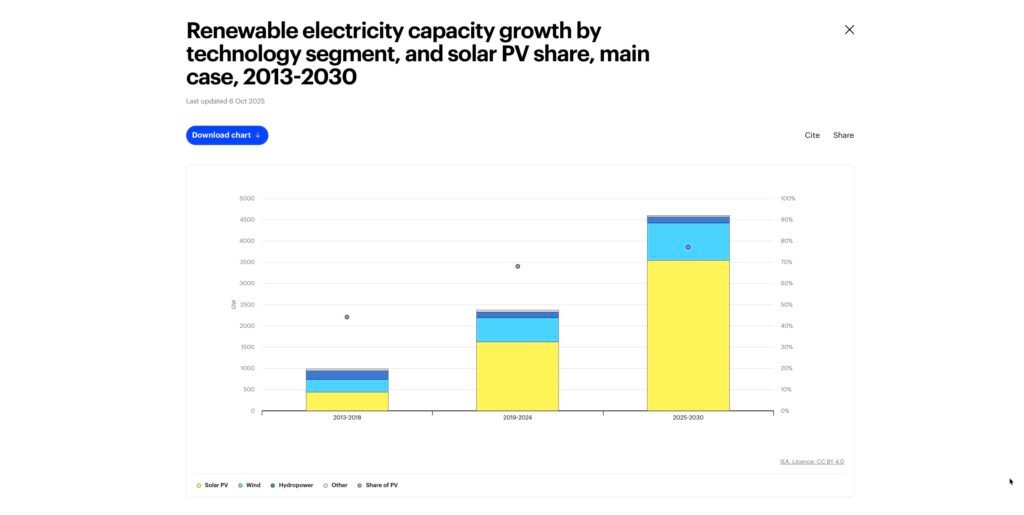
Record-breaking Solar
In 2024, almost 600 GW of solar was added, a 33% increase over 2023, accounting for 81% of all new renewable energy capacity added in 2024. The IEA expects it to double again by 2030.
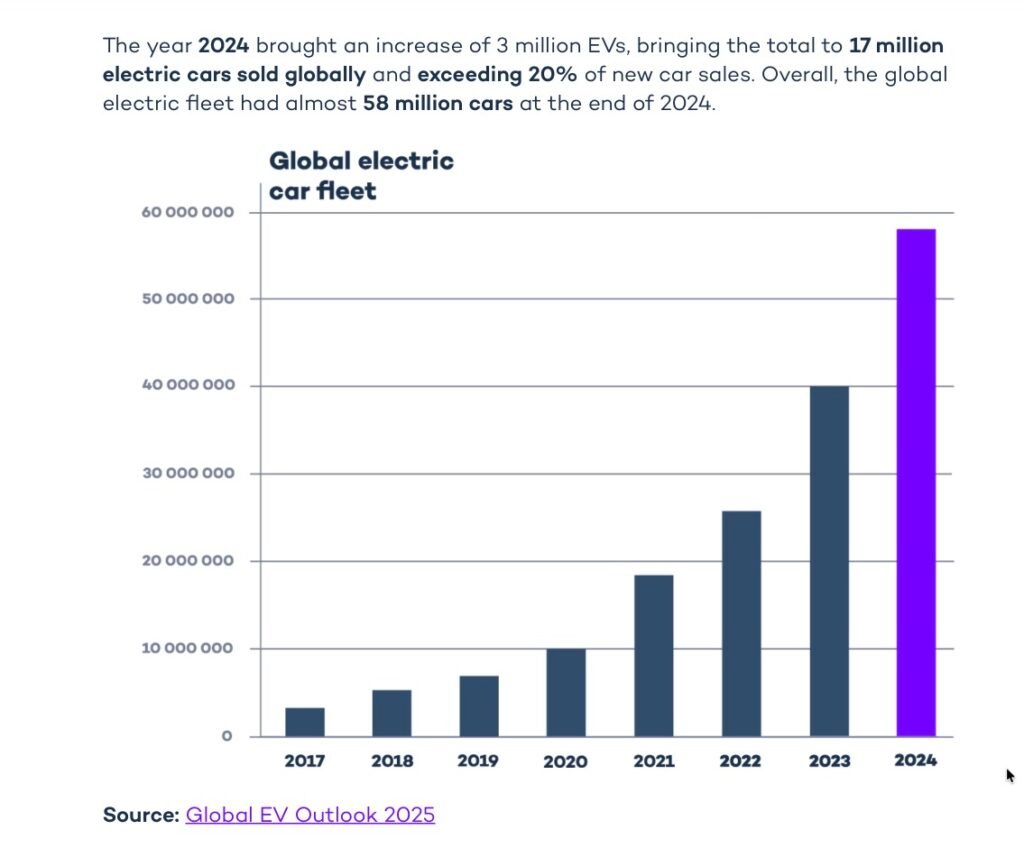
Electric Vehicles
You’ve heard about the sales of EVs faltering in the headlines, but sales are not flatlining – the meteoric growth rates have slowed temporarily. It’s projected that EV sales will grow by 25% in 2025.
Today, one in two car sales in China are electric, one in five sales are electric in the rest of the world, and that figure is predicted to be one in four in 2025.
Energy Storage
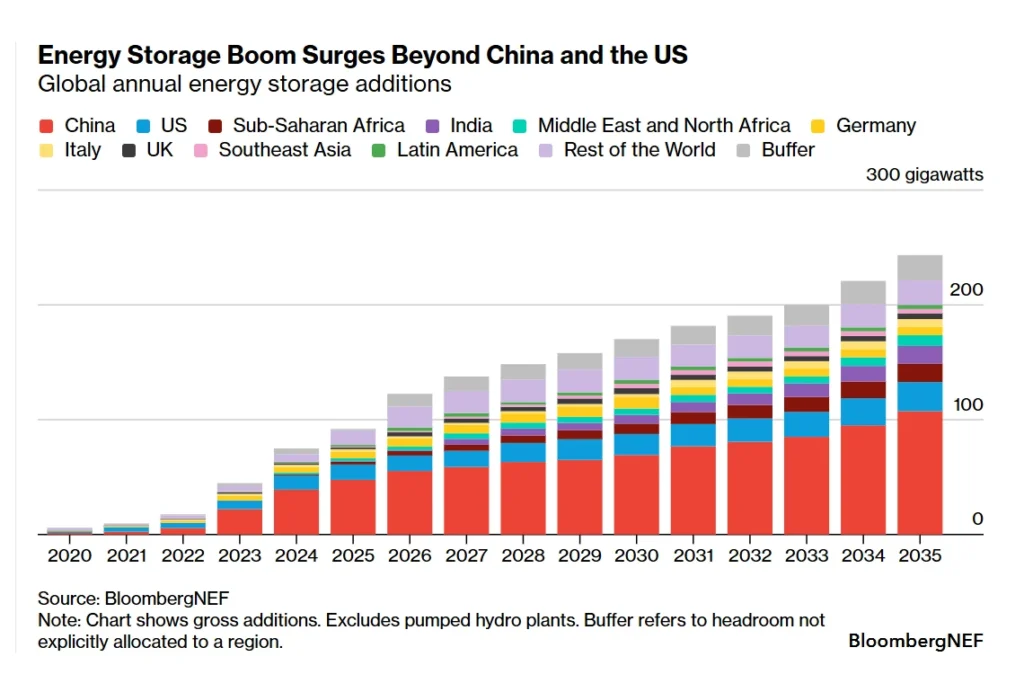
Global energy storage capacity additions to grow 23% in 2025 with China being responsible for 50% of installations. Installed battery storage capacity in California, US has grown from 771MW in 2019 to more than 15,500MW as of 31 January, 2025.
