
CHASING NET ZERO
By David Dodge, GreenEnergyFutures.ca
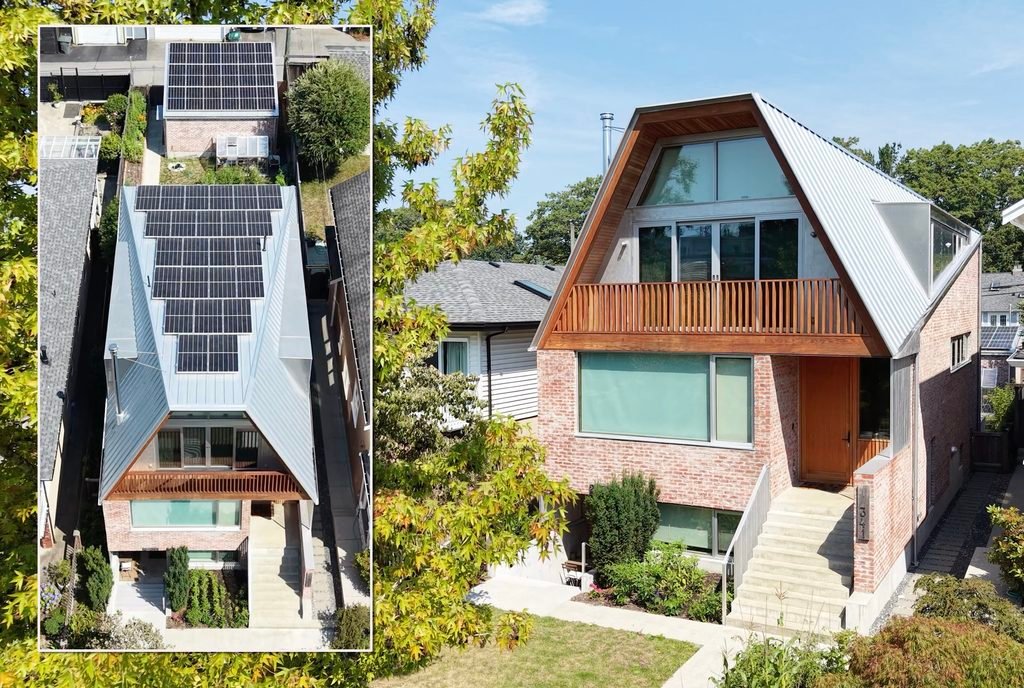
Standing in front of a charming brick heritage home in Vancouver, Stephen Nestmann of Nestworks Construction smiles and says, “This is our first energy-labelled net zero house.”
Right from the get-go, the owners knew that they didn’t want to have any gas run to the house at all.
Today Nestworks builds net zero homes, but Nestmann wasn’t building net zero at the time he built this home, and his very green clients weren’t asking for one.
The story of how Stephen built his first net zero home in the city that calls itself the Greenest City in the world is a fascinating journey.
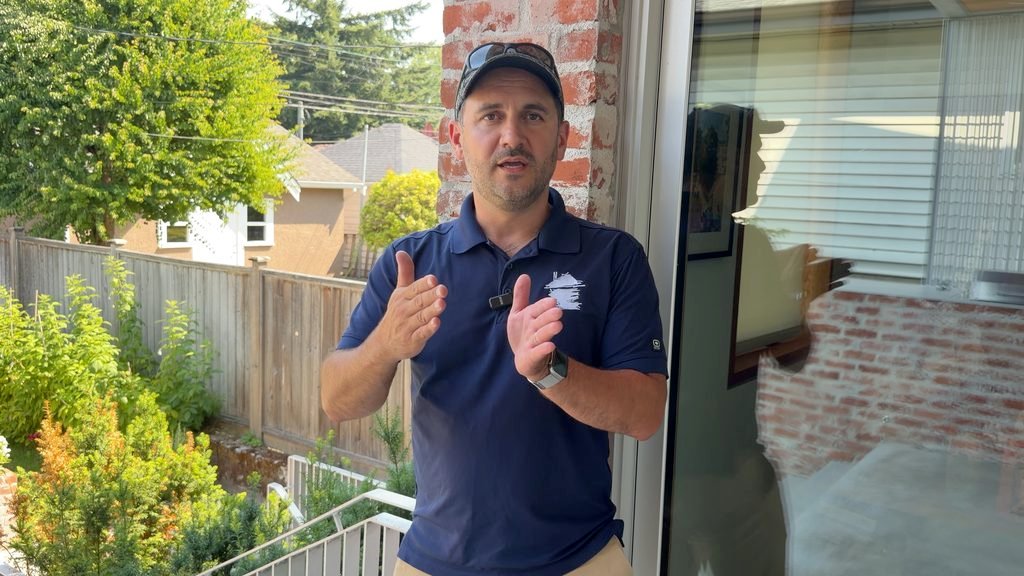
Stephen grew up as a prairie kid in Saskatoon, helping out on the farm. He was handy with tools but started out studying pharmacy in college.
“I followed a girl” to Vancouver, he jokes. “The city was too pricey to keep studying and living there.”
He landed an apprenticeship and became a journeyman carpenter. He enjoyed working for a family business with a great mentor, but he wanted more for his family.
After chatting with a neighbor who already had a permit at City Hall, he found himself in the home building business.
Starting with renovations and heritage conversions, he naturally moved into building new infill homes.
Accidental net zero
These days his company, Nestworks builds mostly net zero and net zero ready homes, but his venture into net zero began accidentally on a project he did three years ago, the home we were standing in front of.
The clients wanted a solar-powered home with no gas.
By this point Nestmann was already building homes with “really high-performing envelopes.”
Taming electricity demand with geothermal
This project presented a few limitations that came up early on. The local electricity grid didn’t have enough power available to power the all-electric home the homeowners envisioned.
We have seen numerous larger homes that required electrical service upgrades to 400 amps to achieve the goals of the homeowners. First, this might not be available. Second, it can be very expensive, and third, builders are realizing there are other ways of achieving all-electric homes that don’t require so much energy.
In this case, Nestmann’s team came up with an elegant solution.
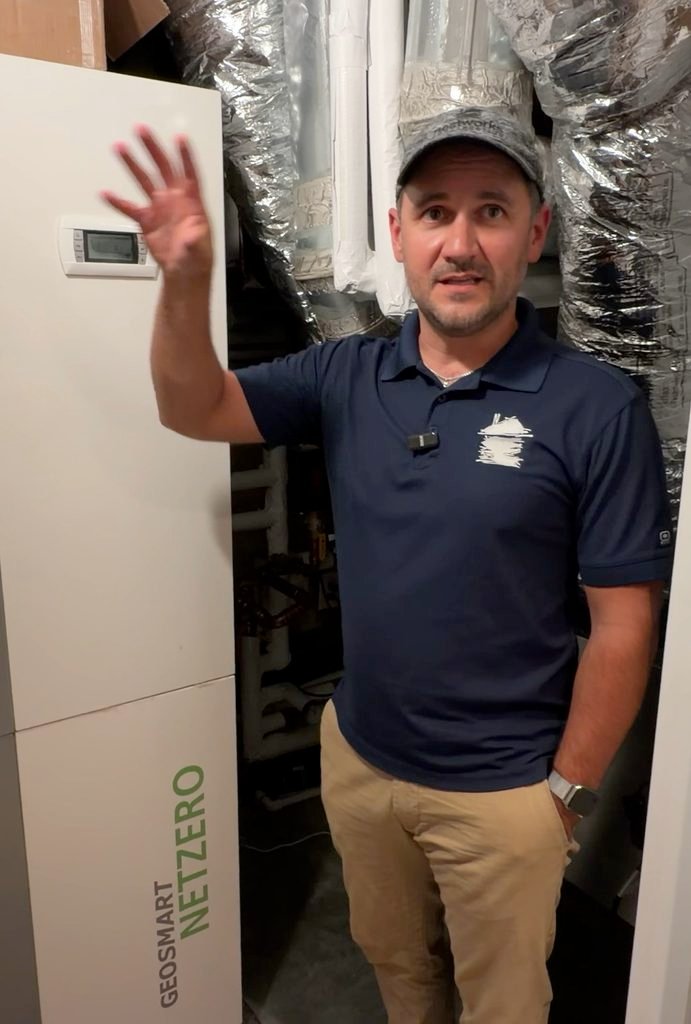
“What we landed on was a geothermal heat pump that provides both domestic hot water, home heating and cooling, and it does all of that on a single 40-amp breaker,” says Nestmann.
Often there are better solutions that are far more energy efficient. One thing the owners did want was a solar system. This was built into the architectural design of the home.
But even now, “It wasn’t even clear to me at that point that we were building a net zero house,” says Nestmann.
“When we got to testing the house at mid-construction for air-tightness, we were below one ACH [air change per hour],” says Nestmann. “I think we were 0.8. ACH and that was putting us in the range where our energy advisor at that point told us, ‘I think this house is going to qualify as a net zero home.’”
This came as a very pleasant surprise to the owners and a “happy accident” for Stephen Nestmann. “We realized we were already building houses that were net zero ready.”
The Greenest City in the World factor
“Most of our projects now are net zero and net zero ready,” says Nestmann.
And he says some of this has to do with the policies of the City of Vancouver.
“They’re really leading the way in terms of building efficiency and green construction. They’ve really positioned themselves as a leader in that space for quite some time,” says Nestmann.
Indeed, a little over a decade ago, it was former Mayor Gregor Robertson who set the bar high.
“When I ran for mayor, I wanted a really clear goal on greening our city,” Robertson told Green Energy Futures in a 2015 story.
“I felt like we needed to push that to the next level and really challenge cities around the world to be greener. So, I ran on a promise to make Vancouver the ‘Greenest City in the World,’” said Robertson.
This goal seemed audacious at the time, and it caught some people by surprise.
Banning gas heating in Vancouver
“Vancouver is a spot where a mayor can make that proclamation, and both the population and the industry kind of started to shift,” says Nestmann.
“It was probably painful at the start,” says Nestmann. “But it has definitely driven change. The industry has evolved, and now we’re in a spot where [we’re] building some of the greenest, most efficient, and environmentally sustainable homes.”
It’s complicated, but Vancouver is a charter city, which means it can set its own building code. That code is already just a whisper away from net zero.
Vancouver has even flirted with banning gas for home heating. The ban was set in 2022 and repealed in 2026. But the votes were close, and the writing is on the wall.
Norway banned gas heating in new buildings in 2017 and is already planning to expand the ban. The Netherlands and Denmark have also banned gas heating and numerous other countries are also implementing bans.
Many builders in our Chasing Net Zero series still use hybrid air source heat pumps with gas backup, but increasingly with improvements in technology builders like Doug Tarry Homes and Watercolour Westport and Avalon Master Builders are offering gas-free, all-electric options.
Stephen Nestmann was always keen on energy efficiency, but he didn’t strive for net zero or net zero ready until he accidentally built a net zero home.
It was then he realized he only needed a few minor tweaks to transition the homes he was already building to net zero ready.
How Nestworks gets to net zero in Vancouver
Living in a rainforest does present some unique challenges, and in recent years builders have learned to take great care to properly manage moisture after the leaky condo crisis rocked Vancouver between 1980 and 2000.
Insulation and Walls
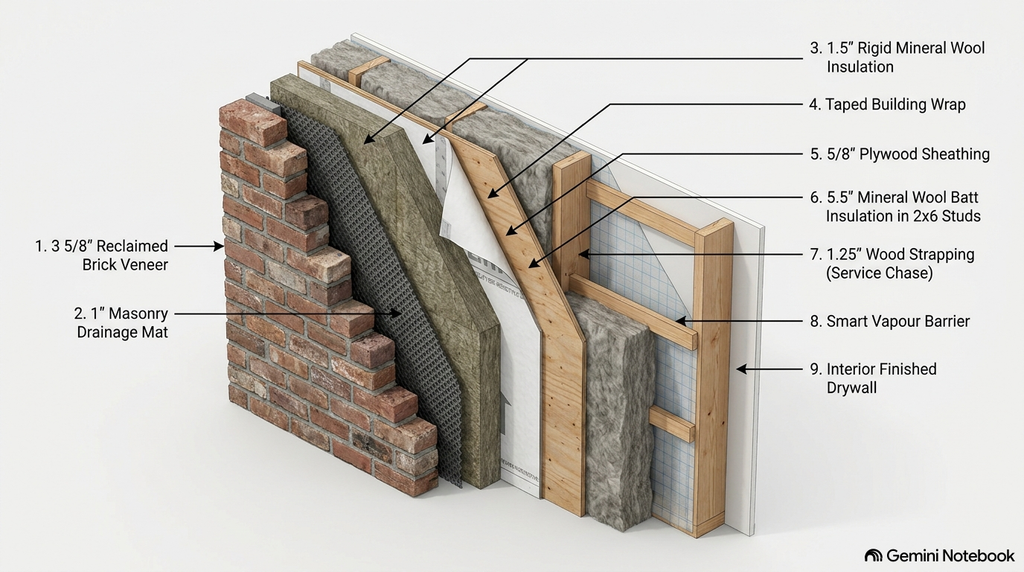
The walls of the home we visited clocked in at an R32 insulation value, which is amazing, especially considering the moderate climate of Vancouver.
The walls use mineral wool insulation in the 2×6 studs, another layer of rigid mineral wool insulation outside the sheathing with a self-adhered water-permeable air barrier in between.
In addition, there is a smart vapour barrier inside behind the drywall.
The owners of this home loved brick as well, and there is a drainage mat behind the bricks as well.
As Nestmann told us, by taking care with the air barrier they were able to keep the air changes down to 0.8 per hour, which is well within the maximum air changes of 1.5 allowed in CHBA’s Net Zero Home Labelling Program.
Nestworks used R15 XPS insulation beneath the basement slab and R60 in the ceiling.
The homeowners really wanted a green home and no natural gas so even though there were not thinking about net zero at the time they did insist that a solar system be included in the design of the home.
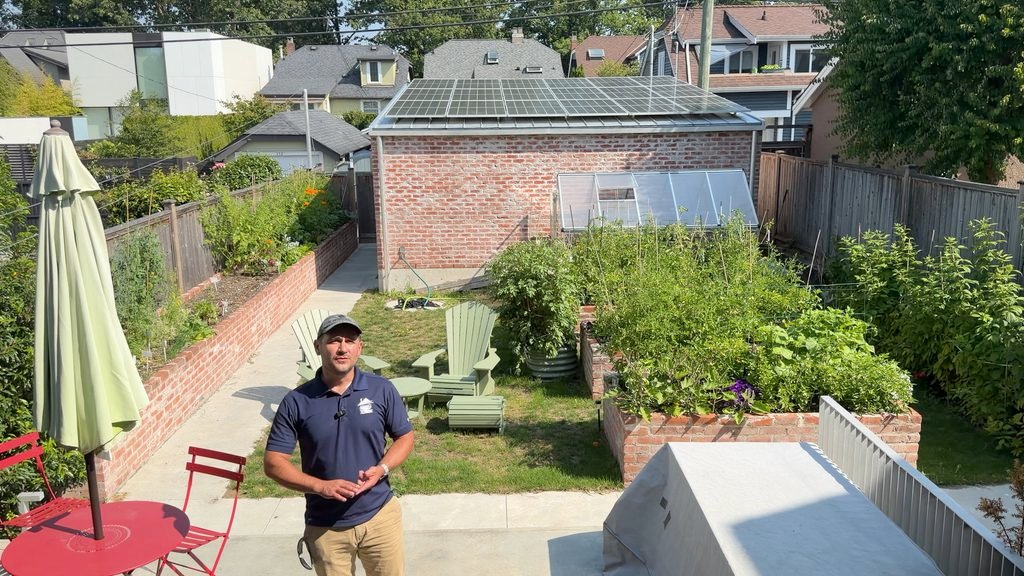
“This home is powered entirely by electricity,” says Nestmann. There are solar modules on the home and garage the electricity runs everything in the home including heating, cooling, domestic hot water and “even an electric barbecue,”
Geothermal
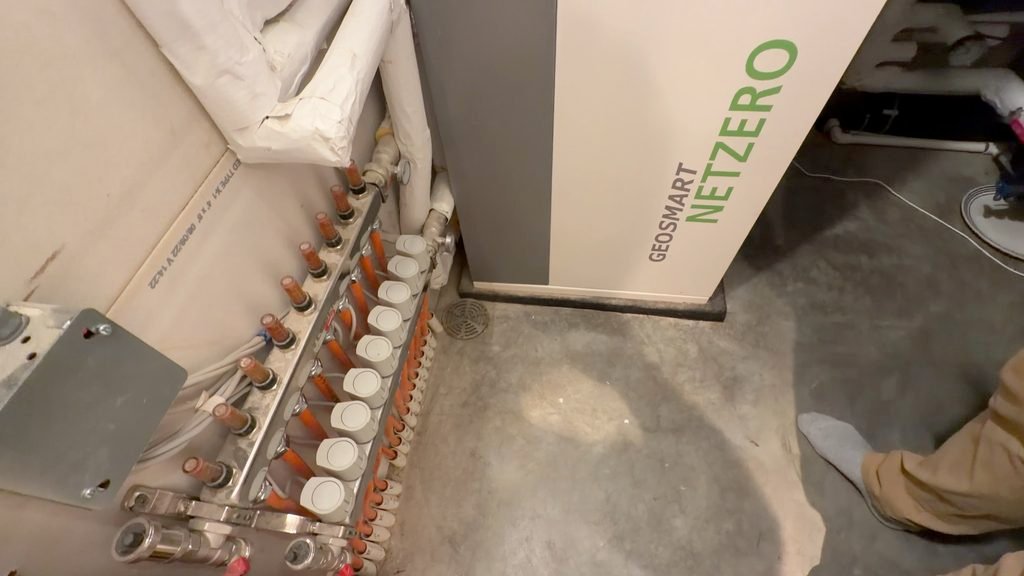
The geothermal, properly called a “geoexchange system” is the really key ingredient in this home. It provides hot water for home use and the in-floor radiant heating system as well as cool air for air conditioning in the summer.
The system helped dramatically reduce the electricity demand in this all-electric home. And “It operates somewhere between 400 and 600% efficiency depending on whether you’re heating or cooling.”
There are other ways of achieving these goals, but in this case geothermal fit in the budget and it is one of the best home heating systems for an all-electric home.
There are more inexpensive solutions if you do away with the in-floor heating, but Vancouverites love in-floor heating, just like Ontarians have a love affair with bricks.
Ironically you don’t really need in-floor heating in a net zero home since the insulated pad feels warm to the touch already, but it is a must for many people.
Speaking of bricks, one of the homeowners is from Ontario and “Brick was a part of the architectural style that she really loved. And these bricks, in keeping with the [green] spirit of the project are reclaimed bricks from the dismantling of a cannery facility,” says Nestmann.
The home also makes use of local Douglas Fir, reclaimed wood from the original home, locally source metal features and stone from a Vancouver Island quarry.

Net Zero with benefits
This project was done three years ago, and it was the first CHBA Net Zero Labelled Home for Nestworks Construction and Stephen Nestmann has never looked back.
“We’re seeing a lot more work come to us that is net zero from the outset,” says Nestmann.
There is also another big benefit of going net zero in Vancouver: you are able to increase the floor space in your home by 19% if you are building a net zero home. As it turns out, this is a very attractive bonus for builders and consumers alike in a City where there is no new land, only infill.
As a prairie kid who started building homes because it was hard to afford one, Stephen Nestmann has developed a reputation for building amazing net zero homes.
Next time we will visit Point Grey on English Bay to see one of the cleanest, simplest, most beautiful net zero homes we’ve seen.
Chasing Net Zero Series – Why Your Next Home Should be Net Zero
We are on a cross-Canada tour to share the stories of Canada’s best builders of high performance, super energy efficient homes that are the homes of the future you can live in today! Get ideas for you existing home, or see what your new home could be like.
Check out these stories and subscribe on YouTube and follow the Chasing Net Zero series. You will inspired.
Steve Rolston had a Vision for a Walkable, Net Zero Community
Steve Rolston Built an entire community of net zero and net zero ready homes in Watercolour, located in beautiful Westport, Ontario
Building Net Zero and Only Net Zero
Doug Tarry was determined to build better homes and is one of the first builders in Canada to build only net zero and net zero ready homes in St. Thomas, Ontario
Net Zero for Zero Extra Dollars
Chris Williams has helped pioneer high performance homes and now builds net zero in Calgary, Alberta that costs you less to own starting in month one!
