

By David Dodge, GreenEnergyFutures.ca
A former building inspector went to work for Doug Tarry Homes in St. Thomas, Ontario, because after a great deal of research and advice, Doug Tarry nailed net zero.
Doug Tarry consulted building science experts and even started his own HVAC company before settling on the design of his net-zero-ready homes.
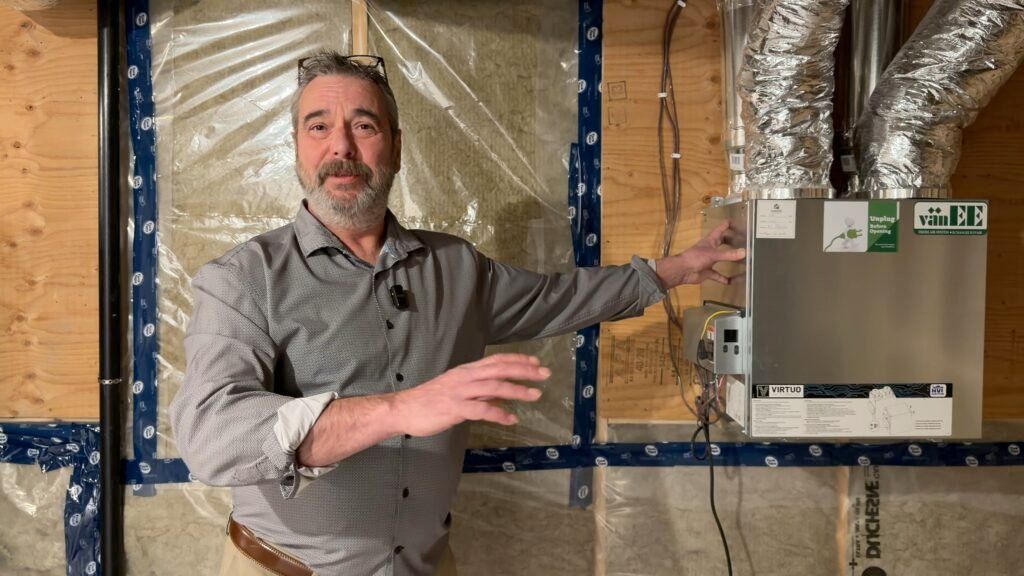
“I had been a building official for about 18 years. And I’d met so many different builders, and when I saw the way that Doug built things, I thought, this is probably the best you can do,” says Jamie Yokowskie, a former building inspector who now works for Doug Tarry Homes.
“You don’t have to put tons of insulation everywhere. You have to put the right amount of insulation in the right places,” says Yokowskie.
Indeed, you need everything right-sized for the optimal build that can be offered at the optimal price.
Doug Tarry consulted building science experts and even started his own HVAC company before settling on the design of his net-zero-ready homes. Affordability affected every decision in the process because he wanted his net-zero homes to be accessible.
Doug Tarry was passionate about getting to net zero affordably, but he knew in the end it would be consumers who needed to approve his efforts.

Taking net zero to the streets
All the blood, sweat, and tears paid off because since the fateful decision to go all net-zero-ready, Tarry has built and sold 686 net-zero-ready homes all labelled under the Canadian Home Builders Net Zero Home Labelling Program.
Heck, some people who buy the homes may not even be aware they are buying some of the best homes ever built.
Suzie Dennis is head of the sales and marketing team at Doug Tarry Homes, and she says they tend to focus on the features of the home that strike emotional chords when selling homes.
But Doug Tarry believes so strongly in his net-zero mission that even his sales staff have caught the bug, and they are getting quite good at explaining the amazing features of these homes without scaring away customers.
We asked Suzie Dennis what she tells customers. “And I say, it’s the things you can’t see. It’s the heart of the home. It’s not that people don’t love the quartz and all the pretty paints and the styles of the home,” she says.
But “It’s the sub-slab insulation, it’s the triple-paned windows. It’s all those things that you can’t see that make a difference in making the home more comfortable, durable, and just a better place to live,” says Dennis.
We wanted to know what the key ingredients are in a Doug Tarry net zero home. There are probably a 100 different cool features in his net zero homes, but we pressed him to narrow that down a bit.
“I’m going to give you four critical paths for getting to net zero,” he says.
Five Key Features of a Doug Tarry Net Zero Home
1. Air Tightness
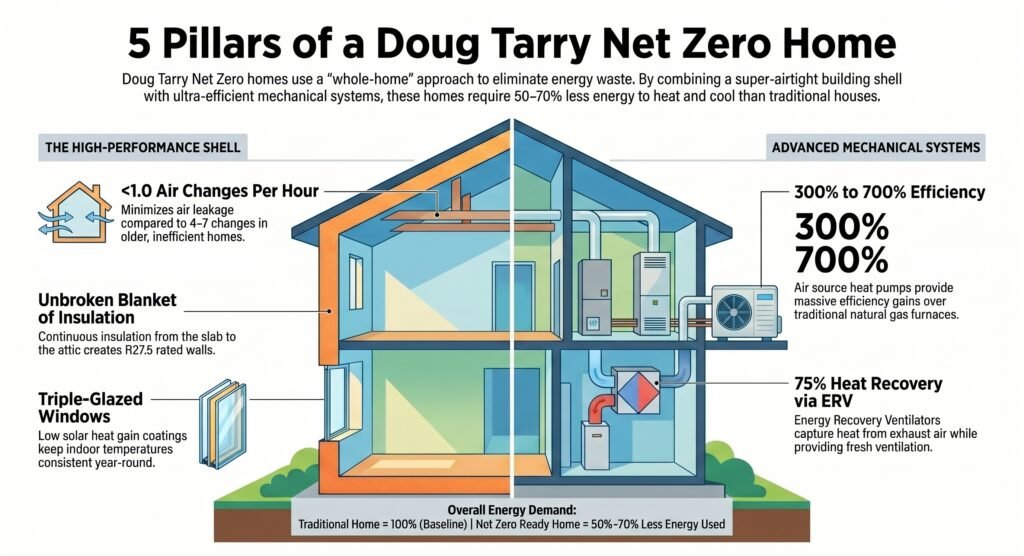
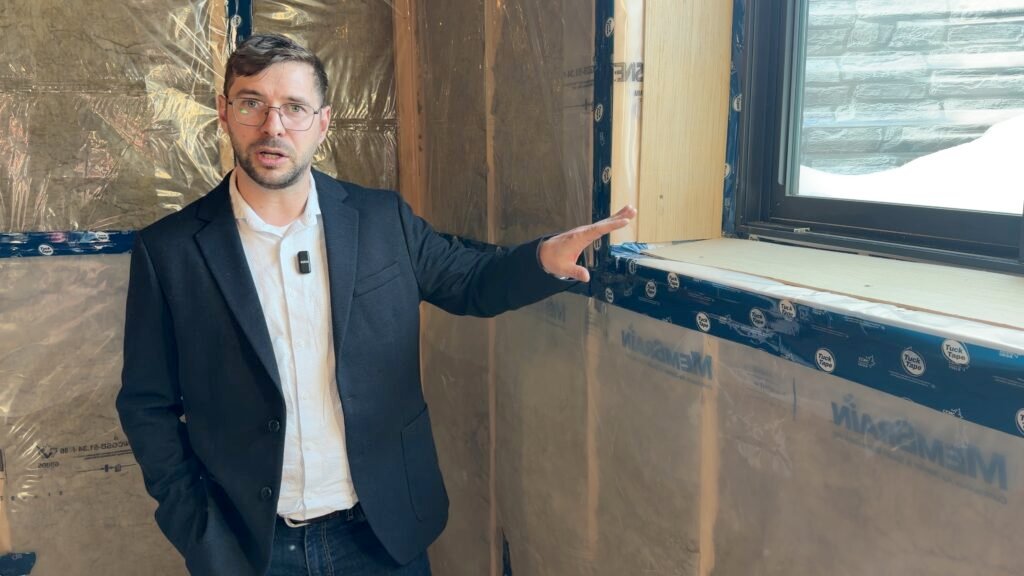
“The first one is about air tightness,” he says. Modern high-performance homes are far better than older homes at slashing air leakage, which is the simplest way of saving heating and cooling energy. Most vent holes are eliminated, and a water-permeable air barrier is added to the entire home and taped up tightly. Homes in the past would have allowed 4-7 or more air changes per hour, meaning you are reheating all the air in the house over and over again.
Net zero homes have one or fewer air changes per hour, with some getting down to 0.5 air changes per hour. This makes a very big difference in cutting energy usage.
This is the best way to transform your home into energy-efficient, comfortable havens, says Homesol Energy Solutions.
2. Envelope (insulation)
Tarry says the second factor is the building envelope and insulation.
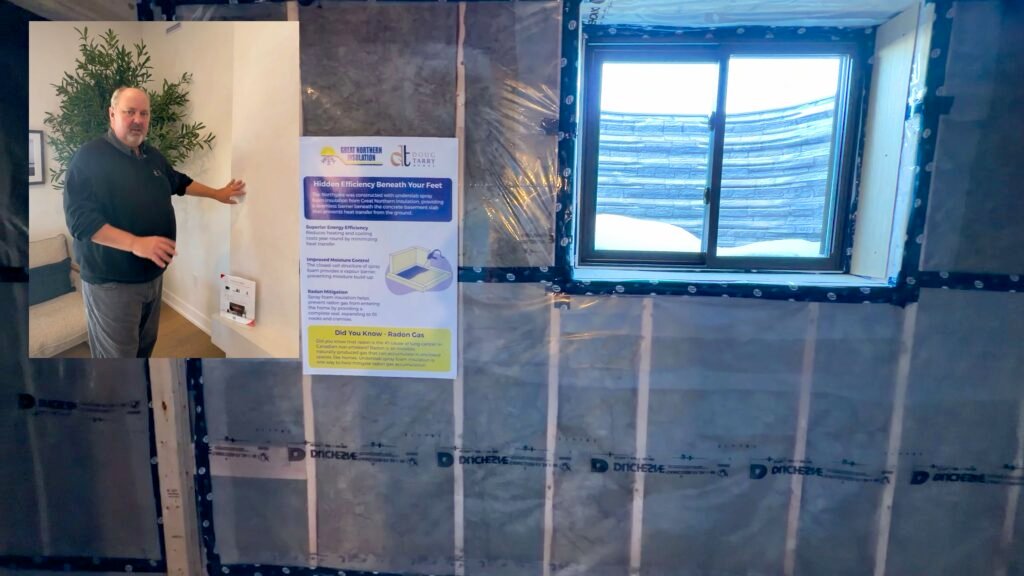
“I think the biggest contributor is the continuous insulation under our slabs, on our foundation, upper walls, and across our attic,” says Yolkowskie.
It actually feels warm on the basement floors of these homes.
The amount of insulation is increased, but as Yolkowskie says, it is the unbroken blanket of insulation that makes a big difference. The 2×6 walls use R22 bat insulation together with two inches of foam insulation on the outside. This creates an R27.5 wall.
Older homes have holes all over the place: bathroom fans, stove fan, dryer vents, and more. In the past, these were wide open to those -30C days of winter. (see ERV later in the story)
See specifications for Doug Tarry Homes here.
3. Windows
“The third one. Which might be the most important one, in my opinion, are the windows and the low-solar glass,” says Tarry.
“It’s a triple-glazed, like all of our above-grade windows, and it has a low solar heat gain coefficient on it,” says Mike Fishback of Doug Tarry Homes.
“So really what we’re doing is we’re limiting the heat from the sun coming in so that the mechanical system can do its job and keep everybody comfortable.”
It may sound counterintuitive, but by limiting the passive solar heat gain, the indoor temperature stays pretty consistent, which makes it easier for the heat pump system to heat and cool the home as needed. Strategic overhangs are also used in some cases to limit the exposure to the hot summer sun.
4. Heating and Cooling – Air Source Heat Pump
In the early days of designing net-zero homes, Doug Tarry was frustrated trying to find just the right heating systems for his homes, so he started his own company, Abode Home Comfort.
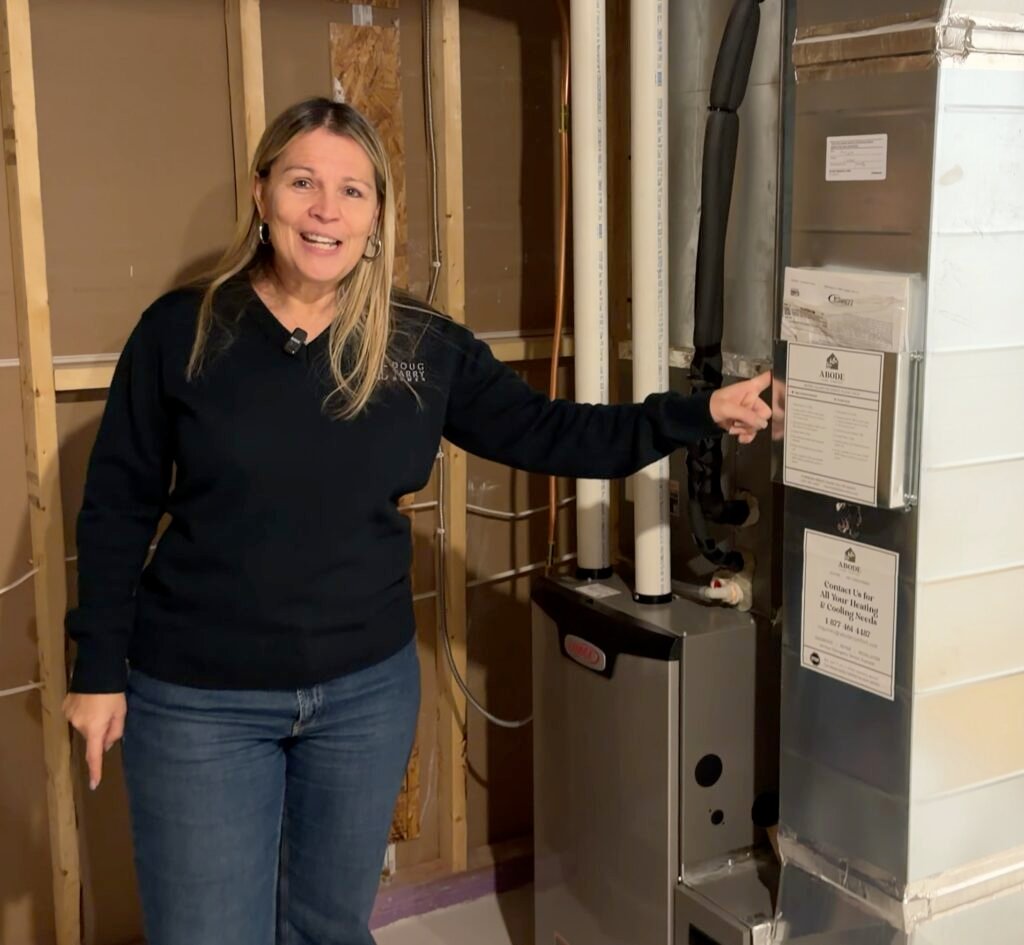
“I think one of the most important ingredients in the secret sauce for getting Doug Tarry to net zero would be the heat pump system,” says Jean-Paul Fortier, who works for Abode Home Comfort.
“What we have here is a dual-fuel system with the heat pump coil on top, and also there’s the outdoor portion for the heat pump outside,” says Fortier.
The heat pump is part of a forced-air system that has backup natural gas heat for the coldest days of winter.
The heat pump does most of the heating in the home, he says.
All-electric subdivisions
For some builders and customers, the natural gas backup unit instills confidence in these new fangled heat pump systems. But as Fortier explains, this is changing over time.
“We are currently doing subdivisions that are all-electric homes,” says Fortier. “There’s no gas run to the homes at all, or even on the street. We’re installing air handlers with electric backup and heat pumps,” and that’s all the home needs.
The best part about no gas is no gas bill.
“These are net zero-ready homes, and all you have to do is put solar panels on the roof, and you’re ready to go,” says Fortier.
“Heat pumps will be standard in the future going forward,” predicts Fortier.
Heat pumps are up to 300% efficient in heating mode and up to 700% efficient in cooling mode.
5. ERVs – Fresh Air and Heat Recovery
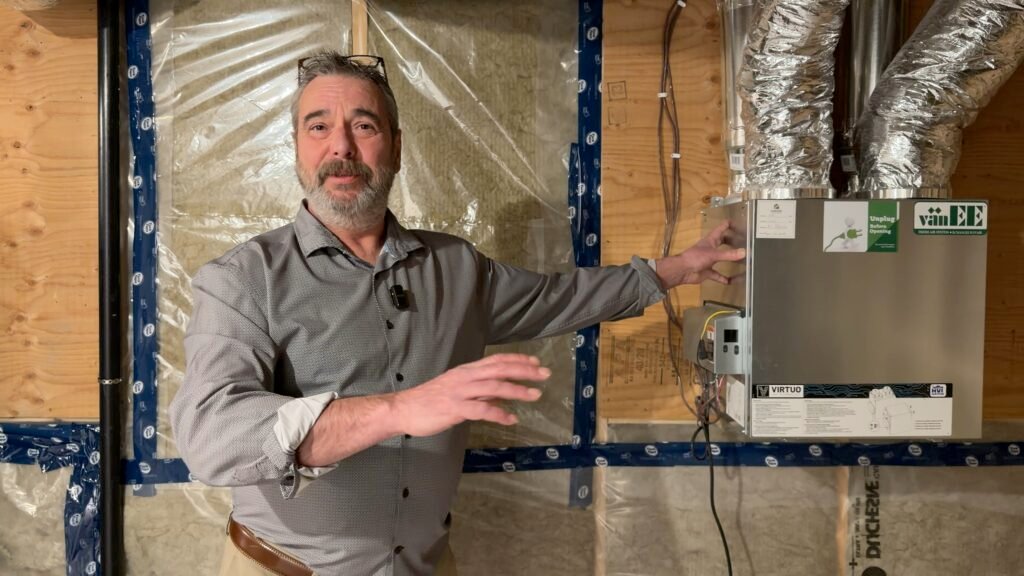
“One thing about having a super airtight home is you have to control your ventilation,” says Yolkowskie.
The energy recovery ventilator (ERV) controls all ventilation of the home. It brings in as much fresh air as you want and it recovers up to 75% of the heat from exhaust air being ejected from the home.
Builders are increasingly using ERVs instead of HRVs (heat recovery ventilator) because the ERVs help manage moisture levels in the home in addition to recovering heat.
This is a massive improvement over the old systems. Remember, our homes once had many vent holes which were totally open to the outdoors even when it was -30C. If you have a vented dryer, then you have probably felt the -30C air coming down the pipe into your home.
Efficiency on steroids
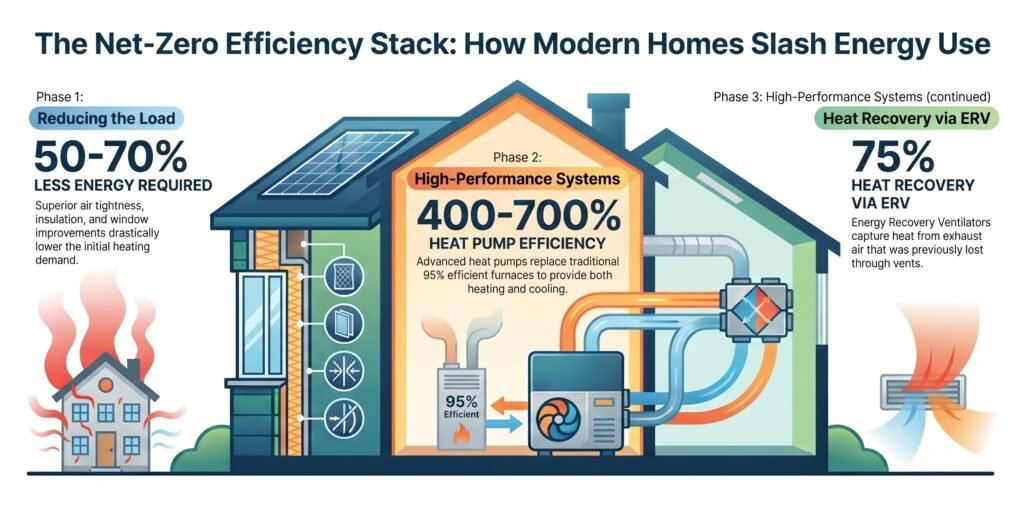
Innovation has introduced dramatic energy efficiencies to every component of these homes. First, air tightness, insulation, and window improvements mean you require 50-70% less energy to heat these homes.
Then, instead of using a 95-98% efficient furnace, you are using a 400-700% efficient heat pump, which both heats and cools your home.
Then, you have not only plugged all the holes in your home by using net-zero design. But the energy recovery ventilator captures up to 75% of the heat from exhaust air. The difference here between the old days of homes with multiple open vents and these new tight homes with ERVs that recover most of the heat in waste air is astronomical.
Other cool stuff
Those are the key ingredients of Doug Tarry’s net-zero homes, but there are a myriad of other innovations as well, a few of which we feel compelled to mention.
- First, the hot water heater also uses an energy-efficient heat pump;
- There is a drainwater heat recovery system on the drain pipe which recovers heat from your hot shower water as it goes down the drain. The bigger your family, the more you benefit;
- On the foundation walls is an inch and a half of rigid foam insulation, then rock wool insulation, and then they use two different kinds of poly vapour barriers. The upper half of the foundation wall uses a smart membrane poly which allows moisture to migrate out of the wall (this is the first time we’ve seen this);
- Under the basement floor is spray foam insulation so the floor always feels cozy;
- The air distribution system uses a flex duct system to distribute lower flows of air continuously around the home, creating a very comfortable environment;
- Every home also has a radon system roughed in. If it’s needed, a fan system is added later to remove the radon.
If there is one thing we have learned from covering the evolution of net-zero home building over the last 15 years, it is that there is no one final recipe for net-zero.
For decades, very little changed with how our stick-built homes have been constructed, and then we dabbled in energy efficiency starting in the 2000s.
But the push for net-zero has brought game-changing improvements in how homes are built, making these some of the most comfortable, energy-efficient, and climate-resilient homes ever built.
It’s an evolving landscape of innovation.
Some custom builders are building amazing double-walled homes, and passive house-certified homes are absolutely amazing, but they are aimed at a certain upper market segment.
But what Doug Tarry is building are affordable, super energy-efficient, net-zero homes for the rest of us.
Chasing Net Zero Series
We’re travelling across Canada to tell the stories of the best net zero home builders in Canada. Here is a playlist of our stories – subscribe to the series and don’t miss a single episode.
