
By David Dodge, GreenEnergyFutures.ca
On April 1, Alberta and Ottawa missed the deadline to finalize negotiations on their MOU on energy and climate, instead agreeing to iron out the details over the coming year. We wanted to do a deep dive into the shell games surrounding an industrial carbon price so critical to the agreement.
Premier Danielle Smith seemed pleased with the compromises Prime Minister Mark Carney seemed to be offering in the proposed MOU last November, calling it a “historic reset” of relations.
In post on Bluesky about his story ”The method to Mark Carney’s madness” in the National Observer, columnist Max Fawcett said, “Mark Carney managed to trade a pipeline that will never get built for meaningful progress on industrial carbon pricing and electricity interties — both of which will get more wind and solar built.”
And so, the seemingly impossible happened: Alberta believed a beleaguered relationship was reset, and Carney seemed to find a compromise that just might reset Alberta’s reluctance to take any meaningful action on climate change.
Many accused Carney of selling out climate change in response to the MOU, but a few like Fawcett believed Carney was playing a long game.
The centrepiece of the deal was to bring Alberta up to an “effective industrial carbon price of $130,” which on first blush seemed low to those who are aware of the federal government’s goal of reaching a price of $170 per tonne by 2030.
The MOU was characterized as relaxing Canada’s Clean Energy Regulations and allowing pipelines, but on the flipside it also addressed interprovincial electricity transmission, clean energy, methane emissions, action to reduce carbon emissions, and the industrial carbon price.
When a carbon price of $95 actually means a price of $20
We wanted to dig deeper into what’s behind the carbon price, and it turns out industrial carbon pricing is a complicated shell game, and that the nameplate numbers do not represent what’s actually happening.
The goal of the MOU from the federal government’s perspective is “to get to an effective price of $130 a ton. And there is a critical difference between that headline carbon price or nameplate carbon price and the effective price,” says Janetta McKenzie, the director of oil and gas for the Pembina Institute.
Alberta currently has a “headline price” of $95 per tonne for carbon emissions, but here’s where the shell game comes into play.
“Over the last few years in TIER [Technology, Innovation and Emissions Reduction Program], the effective price or the price of credits has been really, really low. It’s been ranging anywhere from in the $20s to in the $40 per ton,” says McKenzie.
In fact, 90% of the time, emitters in Alberta are not paying $95 per tonne; they are actually buying cheap carbon credits for $20 to $40 per tonne and even as low as $17 per tonne.
And therein lies the shell game. Alberta can say the price is $95, and in reality, it is much lower.
“This basically matters because if the effective price is too low, then firms and industrial facilities are not going to feel an incentive to invest in decarbonization or emissions reduction,” says McKenzie.
The magic of $130 carbon price
The magic of a $130 “effective” carbon price is that’s when it starts to have an impact, and actions to reduce emissions become economically viable to undertake.
The oilsands industry Pathways Project is a massive effort to capture carbon and reduce emissions from the oilsands. They brag about this all the time and even advertise it during Blue Jays games. But without an effective carbon price of at least $130 per tonne, it will probably never happen.
As for methane emissions, Alberta is pushing back there as well. The federal government wants a 75% reduction in methane emissions (an 80 times more potent greenhouse gas than carbon dioxide) by 2030 (relative to 2012 levels) and seems to have conceded to Alberta’s desire to reduce emissions 75% by 2025 (relative to 2014 levels).
We are just scratching the surface of the MOU here, but if you really want to dig into the details of how the MOU proposes to deal with the extremely problematic methane emissions, check out this interview between Markham Hislop of Energi Media and Amanda Bryant of the Pembina Institute.
The timeline is five years slower and relative to a different baseline – more shell games to keep us, the public, confused. And the result, according to Pembina, would be 1.9 million tonnes of additional methane emissions.
To be fair, the federal government says it will only stand down once an “equivalency agreement” is reached, but time will tell.
Then on Mar. 4 a joint agreement was signed between 10 provinces and territories, an agreement to strengthen inter-provincial transmission lines to make the grid more efficient, provide energy security for Canadians and facilitate more clean energy on the grid.
The moral of the story is this: this is a very complicated agreement, and you really must look beneath the headlines to discover what is really happening.
What Pembina is looking for in the MOU
The Pembina Institute says it is looking for four key things in the agreement:
- An effective carbon price of $130 by 2030
- Any new rules in Alberta must not create unfairness for industry elsewhere in Canada
- The oilsands companies must immediately put money on the table for their Pathways Alliance carbon capture project
- No taxpayer money for another pipeline
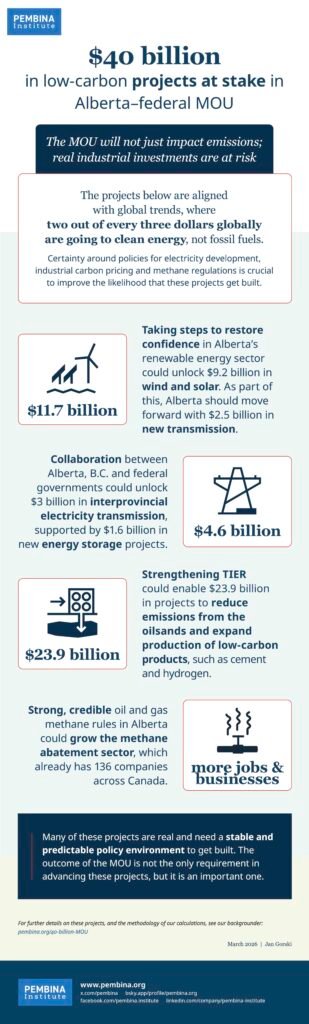
Pembina also says $40 billion in investment in low-carbon projects is riding on a successful agreement, including unleashing tens of billions of investment in clean energy scared away by Alberta’s policies hostile to that industry.
For this and a variety of reasons, the parties failed to finalize the MOU by their own April 1 deadline.
The National Observer reported one of the key holdups “is getting oilsands companies to commit to advancing a huge carbon capture project, a major facet of the agreement.” They are referring to the Pathways Project.
