
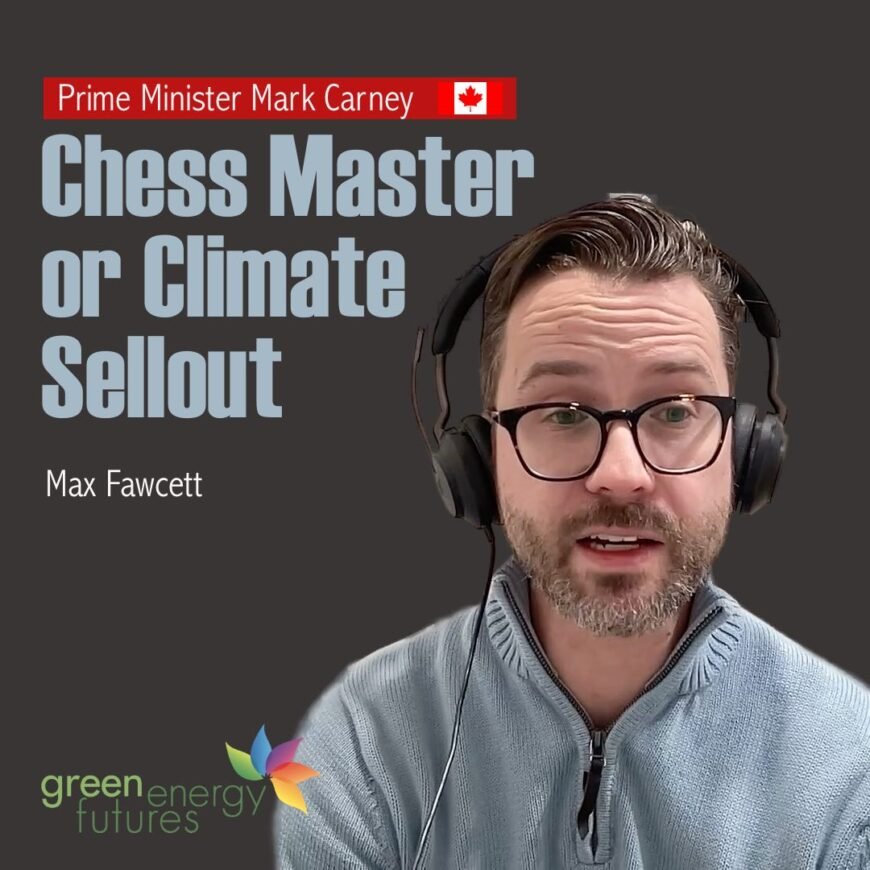
By David Dodge, GreenEnergyFutures.ca
Prime Minister Mark Carney took office with some pretty solid climate credentials, which in the face of a lack of obvious actions, has left some wondering if he is a climate change sell-out.
Upon taking office, Carney nixed the carbon tax and later paused EV mandates and then has recently offered up all sorts of climate concessions to Alberta in a Memorandum of Understanding (MOU) to build an oil pipeline to the west coast.
The MOU was the last straw for Steven Guilbeaut who resigned his cabinet post over the MOU. And Elizabeth May, who supported Carney’s budget, says she was betrayed over assurances that tax credits wouldn’t be offered for enhanced oil recovery in the MOU.
What’s going on here? Is Mark Carney a climate sellout or a political chess master who is playing a long game?
To dive beneath the headlines, we contacted Max Fawcett, lead columnist with the National Observer. Fawcett was once editor of Alberta Oil Magazine, and these days he writes extensively about climate change.
Carney’s climate credentials
First, we wanted to know where Carney’s climate credentials come from.
“They come from mostly his time as the governor of the Bank of Canada and especially the Bank of England. There’s this famous speech he gave in 2015 where he talked about what he described as the tragedy of the commons of climate policy,” says Fawcett.
“Climate change is the tragedy of the horizon,” said Carney in the speech. “We don’t need an army of actuaries to tell us that the catastrophic impacts of climate change will be felt beyond the traditional horizons of most actors – imposing a cost on future generations that the current generation has no direct incentive to fix.”
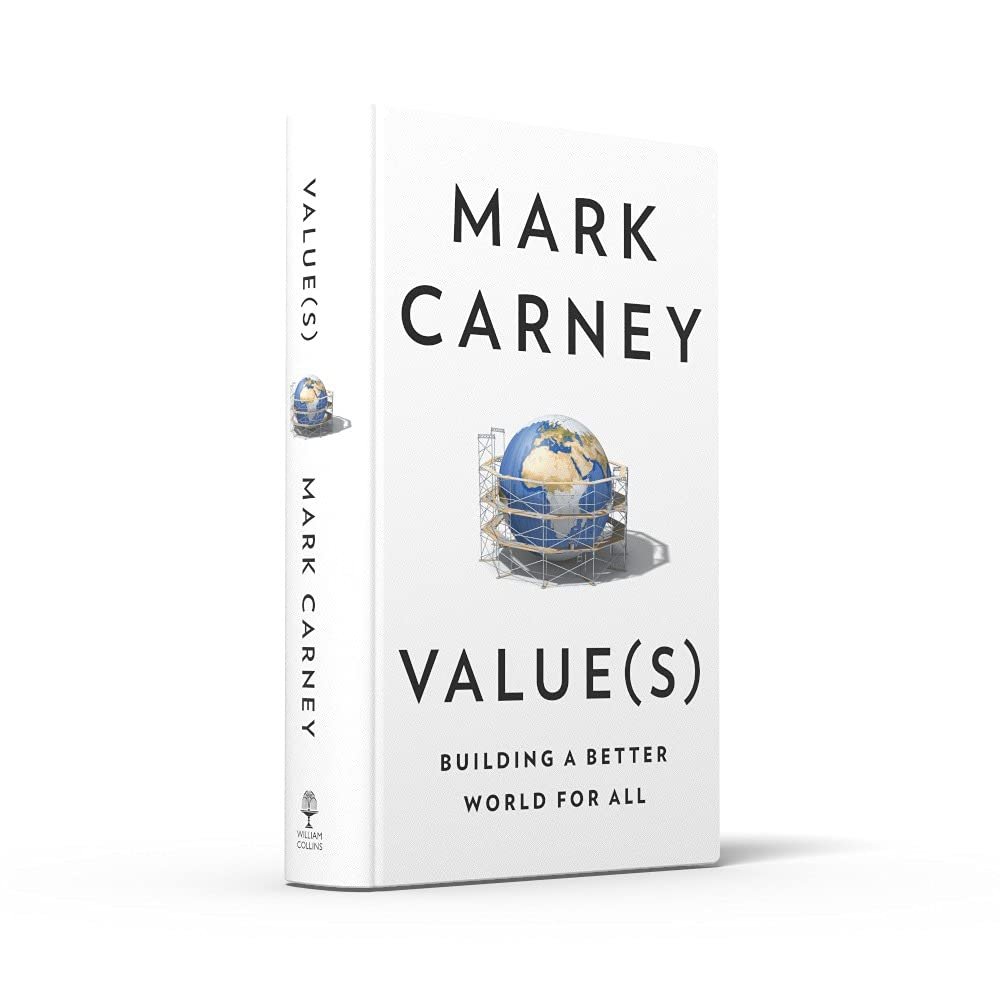
Since then, Carney even wrote a 500-page best-selling book entitled “Value(s)” that includes two chapters on climate change.
Fawcett wrote a review of the book for the Literary Review of Canada and says, “It was definitely a love letter to markets and to capital structures being marshaled as he saw them correctly.”
The US was under a very different administration at the time when Carney said in the book, “Investment must be accelerated at a warlike pace to fight what John Kerry has termed World War Zero.”
He even worked to wrangle investors and bankers to bring climate risk on the books and called on them to invest in the transition to a net-zero economy as the “greatest commercial opportunity of our era.”
Art of the possible
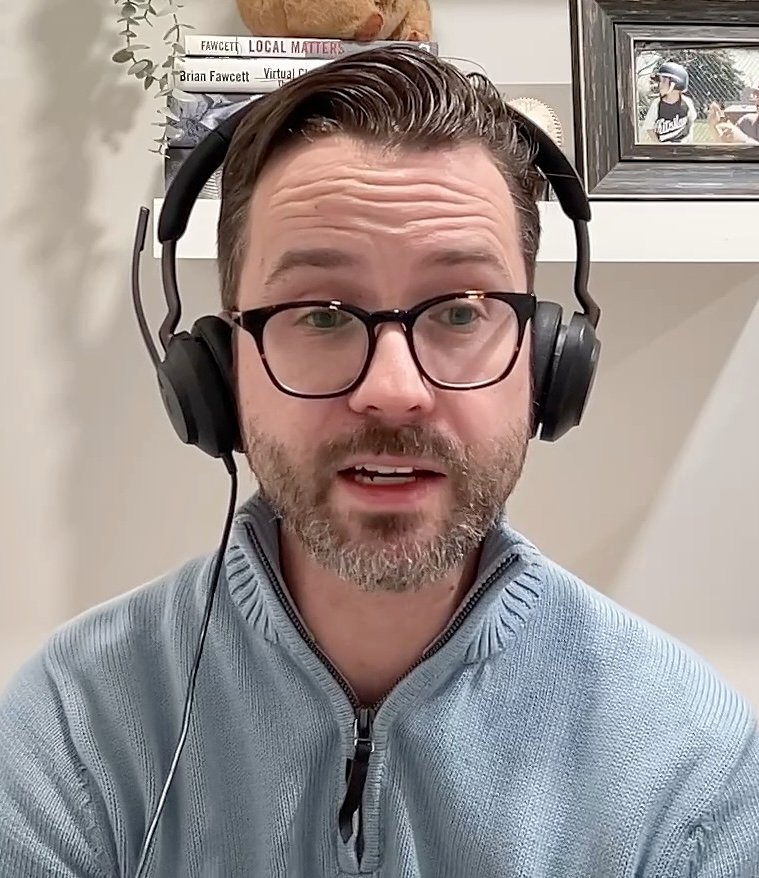
But Fawcett says Carney understands the job as Prime Minister is quite different than being a bank governor or writer.
“As prime minister, you are governing a country, you have people’s jobs and livelihoods depending on you, and it really is sort of the art of the possible. And what is possible in the moment we’re in, especially with climate, is just a lot less than it was when he was writing that book,” says Fawcett.
Then, in a Memorandum of Understanding (MOU) with Alberta, the Prime Minister is offering not to impose a federal emissions cap, trade away the clean electricity standard, adjust the oil tanker moratorium, relax environmental reviews, and he has already relaxed methane emissions targets before the MOU.
This looks bad, bad enough to get climate activists riled up and for at least one cabinet minister to resign.
“What Carney has done here is essentially said I’ll trade away the clean electricity standard. I’ll trade away the oil and gas emissions cap for a properly functioning industrial carbon price,” says Fawcett.
Carbon price shell games
But Fawcett says there is more to this than meets the eye.
“If you look at the research done by Blake Schaefer, Andrew Leach, an economist here in Alberta, if you look at Clean Prosperity in Toronto, they all say getting the industrial carbon price, you know, the credit price [raised] to $130 per ton makes the emissions cap and the clean electricity standard kind of unnecessary,” says Fawcett in an interview with Green Energy Futures.
“The Clean Prosperity report said an industrial credit price of $130 per tonne will deliver three times as many emissions reductions in Alberta as the clean electricity standard,” says Fawcett.

And not mentioned by the mainstream media, the MOU also includes an expanded electricity intertie between Alberta and B.C.
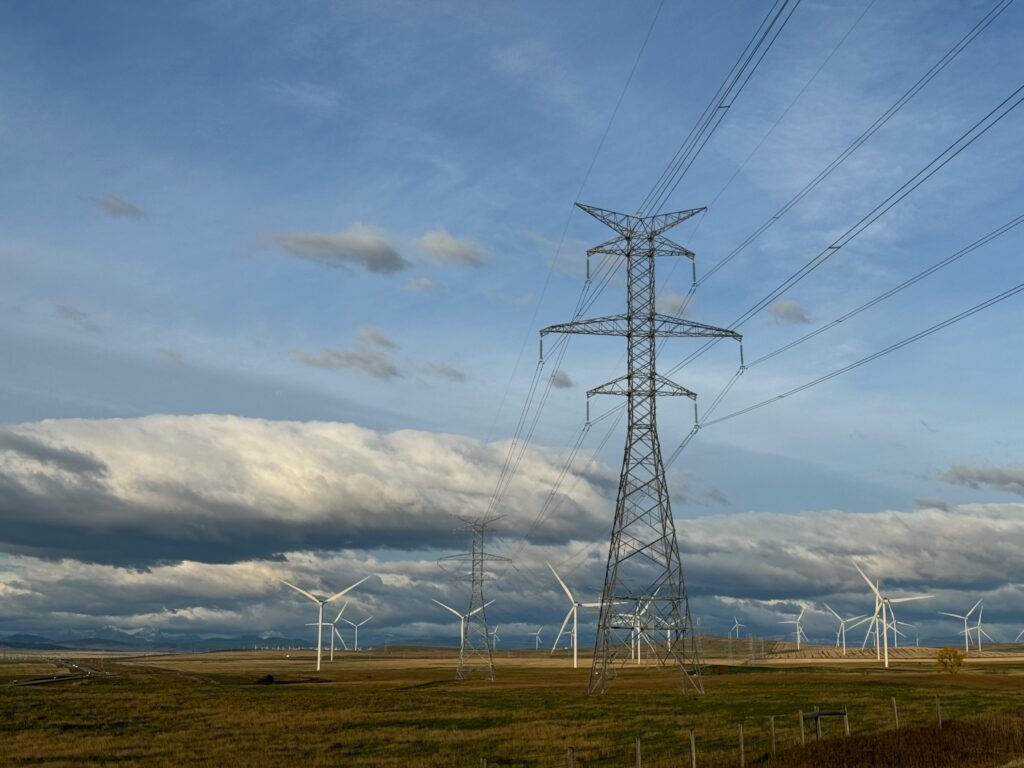
“Once that expanded intertie between B.C. and Alberta is in place, it’s going to do the work the climate folks in Alberta have long talked about, which is pairing B.C.’s hydro with Alberta’s wind and making Alberta’s wind much, much more economical,” says Fawcett.
It seems the Alberta Government and Ottawa look at this intertie differently.
“It is spun [by Alberta] as being for artificial intelligence, decarbonizing oil and gas in the Alberta presentation of it. And I think from the federal government’s perspective, that’s fine. If they think that’s what it’s going to be for, and it gets them to a point where they can sell it, good enough.”
Even if it is used to decarbonize oil and gas, “that’s not a bad thing,” says Fawcett.
Why is the carbon price important?
Ever since the days of Ralph Klein, Alberta has ironically bragged that it was the first jurisdiction to impose a carbon price. But even today, Alberta’s industrial carbon price system is so full of loopholes and shell games that the effective price is much lower.
“They [Alberta] froze the headline at $95 a ton, but the credits are clearing under $20 a ton. That’s what the real carbon price is,” says Fawcett.
“That’s untenable for companies trying to make plans for decarbonization. It’s untenable for attracting low-carbon capital to this province, this country, and it’s untenable for the Pathways Project, which the government of Alberta claims it wants to see built,” says Fawcett.
The Pathways Project is a $16-$24 billion project to capture carbon emissions from the oil and gas industry and bury it beneath the ground. Activity on the project was suspended in December 2024 by the proponent.
Another aspect of the MOU calls for the use of “financial instruments” to backstop the proposed $130/tonne industrial carbon price.
“This is getting super wonky, but basically, I think they’re talking about carbon contracts for differences,” says Fawcett. The idea is to backstop the $130 carbon price in essentially “a financial insurance contract,” says Fawcett.
Chess master or climate sellout?
So, I put it to Fawcett: Is Mark Carney a political chess master or climate sellout?
“I would definitely put him closer to a chess master, although I’m reluctant to give that designation to any politician,” says Fawcett. “What it looks like Carney is doing here is he’s identified the mechanism that will attract the least political blowback from the public. And then he’s going to work on defending it from any future attacks.”
Fawcett says you certainly wouldn’t say many of the Trudeau era climate policies were future-proof.
“To believe that the clean electricity standard would give you those [future] reductions, you basically have to believe that the Conservatives are never going to form a federal government until 2045,” says Fawcett.
“I don’t think Pierre Poilievre is a very good politician, but I don’t think they’re going to be out of power for another 20 years,” he says.
The clean electricity standard was a “dead policy walking,” says Fawcett, whereas Carney is “trading it for a policy that may have a chance of surviving.”
The MOU has been signed, but it won’t take effect unless Alberta finds an investor for the pipeline, does consultations with First Nations and B.C., and signs a final agreement with Ottawa.
“I think that the proof is in the pudding of the agreement on industrial carbon pricing,” says Fawcett. The final agreement could come as early as April, but “I want to see those details. I want to see exactly how long it will take for us to get up to that $130 per ton floor price.”
What about Greener Homes?
The EV mandate was “paused,” not cancelled, and Canadians seemed to love the Greener Homes Program that has expired, so I asked Fawcett if he thinks these will come back.
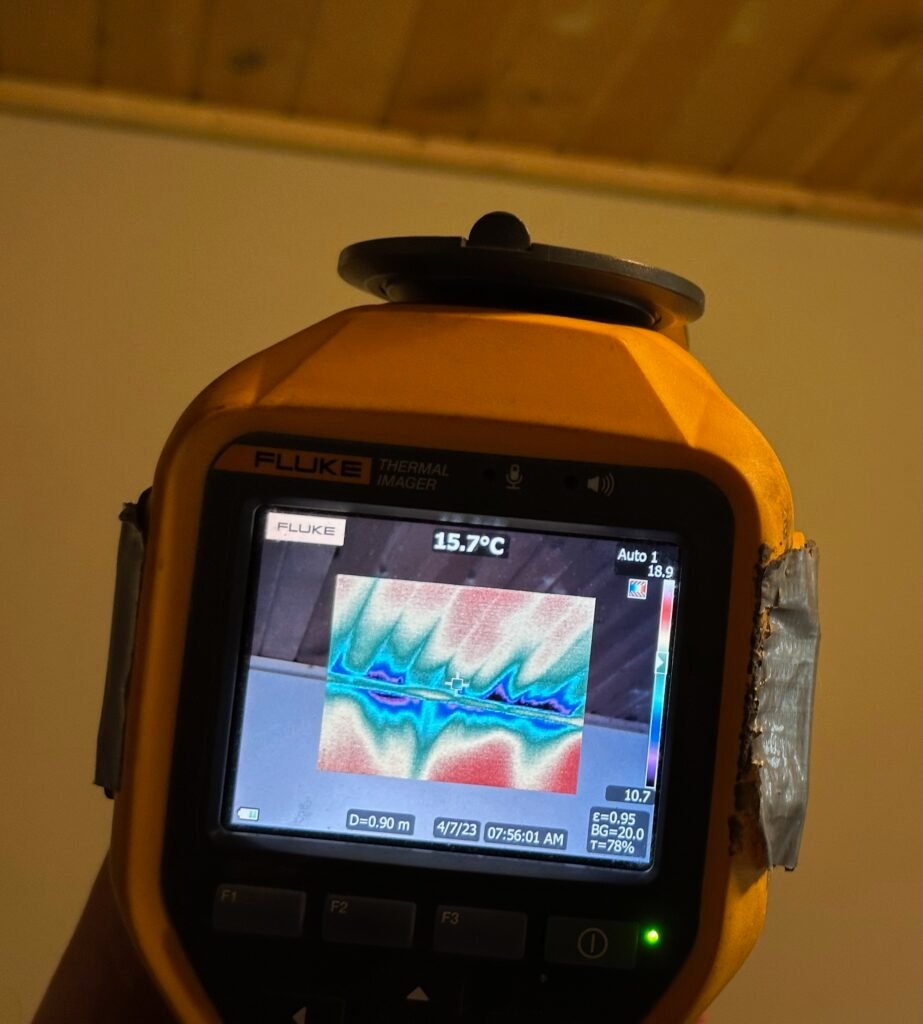
“I would be highly supportive of bringing both of those back. I think the way to get people on board with climate policy is to make it seem like a better way to go about your business. So, if you can get an EV for cheaper than a gas-powered vehicle, that’s the whole ballgame.”
“With the greener home stuff, you’re going to do those retrofits if they save you money,” says Fawcett. And then you’re going to start thinking that climate policy isn’t a cost, it’s a benefit to me. It makes me wealthier. It saves me money. “It’s the whole ball game,” says Fawcett, sounding a little like he may have read Michael Liebreich’s Pragmatic Climate Reset essays.
“I agree completely with Michael Liebreich on finding ways to depolarize and depoliticize climate policy, and to make climate policy kind of interchangeable with cost-of-living policy,” says Fawcett.
Carney has broken the freeze on Alberta-Federal relations with actions such as the pipeline MOU. He seems to have found a pathway that makes Alberta happy and might just get some good climate policy in place.
Time will tell if Carney is a political chess master or not, but thanks to Max Fawcett, we are looking at the Prime Minister’s actions with a great deal more nuance than before.
